In the film Close Encounters of the Third Kind (director Steven Spielberg, 1977), there is a scene where the main character, Roy, plays with mashed potatoes while his family look on in disbelief and despair. His son starts to cry. Since his encounter with a UFO, Roy has become increasingly focused on recreating the mountain shape that has dominated his visions. As a malleable food, the mashed potatoes offer the perfect medium for sculpting the mountain. To be fair to Roy, it’s a pretty good attempt. While the potato sculpture is just another indication of his increasingly strange behaviour, however, it’s the act of playing with his food that seems to bring Roy one step closer to madness.
Even if we haven’t had an encounter with extra-terrestrials, playing with our food is typically treated as problematic: as rude and inappropriate, even potentially wasteful. We might have been told that ‘mealtimes are for eating, not playing’ as a child, and certainly as adults it seems like we don’t even need to be told. Yet we do play with food, quite a lot of the time. And our kids need to learn to play with food: we just need to teach them the rules.
Eating as play
Let me suggest to you that eating, and food preparation, can be a form of play that adults engage in much of the time. This play is at its peak in the moments when food is celebrated or when we’re enjoying a special meal. In some professions, food play is even rewarded with accolades and awards. People get paid to play with food. I can explain this better if we first consider what is play.
Play refers to a whole range of activities that, at their core, involve a combination of creativity or imagination1, enjoyment, and rules. It’s a serious academic subject: studied across a diverse range of disciplines. Many scholars, including the classic work of Lev Vygotsky, have argued that children need play to develop. For example, what is known as make-believe, imaginary, or pretend play (such as Roy’s mashed potato mountain) enables children to use their imagination while still following the rules of play. While these rules might be different from mealtime rules and focused on things like who plays which role or how a toy might sound if it spoke, they are still rules nonetheless.
Now if we take these core elements of play–creativity/imagination, enjoyment, and rules–they can be underlying principles when preparing and eating food. Let’s start with creativity and imagination. The basis of much cooking involves transforming ingredients into an end product that does not resemble the constituent parts. It takes enormous creativity to turn whatever is left in the cupboards into a meal. I’m not talking here about a cheese sandwich or a bowl of cereal. There will always be things that we eat that take no imagination or creativity on our part and I, for one, am very grateful for those foods. But it’s in the alchemy of cooking that play comes to the fore. When runny egg whites become fluffy clouds, or when flour and fats turn into creamy sauces.
Creativity and imagination are more noticeable when we decorate cakes for celebrations. Such creations are often specially constructed so that they resemble something else entirely (i.e. not cake), whether from this world or another.
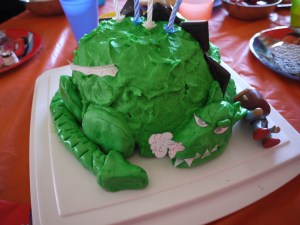
Then there are the chocolatiers–and how fantastic that this can be a career choice–who sculpt or, rather, architect chocolate creations. And the high-end chefs such as Heston Blumenthal, whose imagination and skills have pushed the boundaries around food and the senses.
Our imagination continues when we eat. For those of us who eat meat, we probably don’t want to think about the living animal as we chew on our steak or burger. We imagine the item as simply food, instead. A lot more of us might be vegan if we carefully considered the origins of our food. I remember a rather awkward family dinner at which my brother and I asked our parents where eggs came from. We lost our appetite for a little while after that. But we can also be creative when eating in more positive ways, such as in how naming a dish can change how we respond to it. Two of the most popular soups in our household are named after what they resemble: sunshine soup and swamp soup2. The former consists of mostly yellow/orange root vegetables, the latter has mainly green lentils, sausages, and kale3. My kids actually request the latter on a fairly regular basis. It may not sound appetising, but for us it’s a lot more interesting than simply calling it ‘lentil and cabbage soup’.
The other two main elements of play are also important for eating. When it comes to enjoyment, well, we might not always enjoy cooking nor even perhaps the eating. Sometimes food is simply a means to an end. But sometimes, and at the very best of times, both the preparation and the eating can be the purest of delights. As for following rules, there’s a reason why recipes exist. There are also rules that keep us away from inedible or dangerous objects, rules that guide how we eat according to our age, culture, nationality, religion, state of health, the seasons, celebrations, and national holidays. Rules underpin almost everything that takes place around cooking and eating.
So, I’m suggesting that, as adults, we also play when we’re eating, and yet we still tell children not to play with their food. It’s not as if we are totally serious when eating with young children either. There is a whole industry built around making food ‘fun’ for the kids.
Making food ‘fun’
From the earliest moments of eating, from pretending that a spoonful of food is an aeroplane or train, we spend a lot of time trying to make food enjoyable for children. The food industry has long been focused on appealing to children through the kinds of processed foods that pretend to be something else: the ‘smiley faces’, the cheese strings, the alphabet spaghetti. Then there are thousands of books and websites adorned with images of food that has been fantastically presented as ‘fun’ for children to eat, resembling animals or faces or TV characters. The food used is usually fruit and vegetables, for a reason we’ll come to in a moment. When my own kids were young, I didn’t have the time or energy to make pictures out of food; creativity only emerged for birthday parties. I was more concerned with just making sure everything else fell into place, like family, work, and sanity. In that order.
These attempts to make food fun usually involve presenting vegetables into a more palatable form. While most of us could probably do with eating more vegetables, there are many children who show extreme aversions to new or unfamiliar foods. It is for this reason that the ‘fun foods’ suggestions are almost always about fruit and veg. These are the foods that we need to persuade children to eat. Such food aversions, sometimes referred to as ‘fussy’ or ‘picky’ eating, are the cause of considerable distress for families. Among the many strategies that are used to deal with these aversions, sensory play has already shown some positive benefits. Research is showing how providing opportunities for kids to use their senses–to touch and play with food–can increase their acceptance of those foods. It’s as much about being allowed to play as it is about being familiar with textures. Not all kids (or adults) will be comfortable with this, of course. But for those who are, being allowed to be ‘messy’ can result in enjoying food and being more relaxed around mealtimes.

Meanwhile, despite all the efforts of adults, the kids themselves are already having fun in their own way at mealtimes. We already know that preschoolers joke around and play with their food, that they can use food (like making orange peel into a turtle) to try to engage with their teachers or peers, that they often prefer to play with an object that they can manipulate themselves rather than a ready-made manufactured shape. Building blocks and modelling clay are much more conducive to play because they leave more to the imagination. Just like the malleability of mashed potatoes for making mountains and the versatility of peas for sticking to potatoes. And most importantly: that only can playing and eating coincide, but that the playing can actually help the eating to progress.
We’ve spent so long trying to make food ‘fun’ from an adult perspective, therefore, that we’ve overlooked how kids actually play with food on their own terms and how this can be beneficial.
Learning the rules of play
It is no wonder that our relationships with food can be, at times, confused. As adults we praise imaginative cake or chocolate creations and yet berate our children if they try to make pink clouds by mixing ketchup into their potatoes. We make parents feel inadequate for not having made a train out of nine different vegetables and scold our kids if they so much as put bread sticks under their gums to make ‘fangs’. Some kinds of play are accepted, some aren’t.
We have spent so much time trying to teach table manners and making mealtimes ‘tidy’ that we’ve neglected the joy in eating. We need to see play for what it is: creative, imaginative, enjoyable, and driven by rules. As adults, we can guide children in terms of what is appropriate and what is not. That some forms of play can expand their eating experiences, as long as food isn’t wasted (I’m looking at you, Roy, with your potato mountain). Play can be scaffolded: gently supported while still allowing space to grow. This is not abandoning table manners, it’s redefining what counts as an enjoyable mealtime, for everyone.
We play by the rules, even in play.
Research references
The following are the research papers that are referred (and linked) to in the blog post:
Bae, B. (2009). Children’s right to participate–challenges in everyday interactions. European Early Child- hood Education Research Journal, 17(3), 391–406.
Bateman, A. (2018). Ventriloquism as early literacy practice: Making meaning in pretend play. Early Years, 38(1), 68-85.
Butler, C., & Weatherall, A. (2006). ” No, we’re not playing families”: Membership categorization in children’s play. Research on Language and Social Interaction, 39(4), 441-470.
Coulthard, H., & Sealy, A. (2017). Play with your food! Sensory play is associated with tasting of fruits and vegetables in preschool children. Appetite, 113, 84-90.
Coulthard, H., & Thakker, D. (2015). Enjoyment of tactile play is associated with lower food neophobia in preschool children. Journal of the Academy of Nutrition and Dietetics, 115(7), 1134-1140.
Dovey, T. M., Staples, P. A., Gibson, E. L., & Halford, J. C. (2008). Food neophobia and ‘picky/fussy’eating in children: a review. Appetite, 50(2-3), 181-193.
Holmes, R. M. (2011). “Do you like Doritos?”: preschoolers’ table talk during lunchtime. Early Child Development and Care, 181(3), 413-424.
Mechling, J. (2000). Don’t Play with Your Food. Children’s Folklore Review, 7-24.
Nederkoorn, C., Jansen, A., & Havermans, R. C. (2015). Feel your food. The influence of tactile sensitivity on picky eating in children. Appetite, 84, 7-10.
Wiggins, S., Willemsen, A., & Cromdal, J. (2023). Eating Prickly Peas: Sharing Play Worlds During Preschool Meals. International Journal of Early Childhood, 1-18.
- There is a subtle distinction. While creativity typically involves using things in the real world in imaginative ways, imagination itself does not have to rely on things in the real world. ↩︎
- Not in any way similar to Eowyn’s stew: see ‘Talking with your mouth full’ blog post. ↩︎
- I know, I said there would be no recipes here. This is just an ingredients list. ↩︎
This work is licensed under CC BY-NC 4.0
 Mouth: full