One of the interesting things about food disgust is not just how it sounds, but when.
Take a look at this clip from the Pixar Animated film, Inside Out (2015, Directors Pete Docter and Ronnie del Carmen):
Sounds of disgust like the ones shown in this clip are quite distinctive from other emotional sounds; specifically in the way that they capture a sense of moral judgement. The trick to sounding genuinely disgusted, however, involves not only our own visceral response but also a synchrony with what is going on around us. Timing, as we shall see, is everything. One type of situation where this might occur is during family mealtimes with young children. Another clip from Inside Out shows an example of this when Riley, as an infant, is being offered broccoli for dinner
What you might have noticed in the video clip is how Riley makes sounds of disgust at specific moments – though of course with an edited film, we’re limited to how things are presented – not when the broccoli is first put on her plate but when it is moved closer to her mouth.
The focus of this blog post is about how to really sound disgusted rather than just sounding (out) or expressing disgust.
Matter out of place
Before I get into the specifics of how disgust sounds are produced, it is worth taking a moment to consider the weird and wonderful concept of disgust. Studied by scholars including Darwin, the term comes from 16th century Latin ‘dis’ (reversal) and ‘gustus’ (taste) and therefore the origins of its name suggest a strong association with eating. Indeed, although we can be disgusted by many things, disgust is argued to be the only emotion associated explicitly with food. Broadly defined as a feeling of revulsion at the prospect of ingesting an offensive object, it can be both a noun and a verb; we can experience it ourselves but also cause someone else to feel disgust.
When it comes to food, an important distinction to be made is between distaste and disgust. We might reject food on the basis of sensory factors or preferences (i.e. distaste), but disgust involves an extra layer of moral value. It is not just that it might be unpleasant to eat but that there is something inherently wrong with the idea of eating that object.
One of the main advantages of disgust is that it helps us to avoid disease. In the same way that pain alerts us to the dangers of heat or pressure, disgust alerts us to the dangers lurking in contaminated food or faeces. It can be helpful in changing behaviours in times of infectious diseases, such as washing our hands after touching door handles or keeping our distance from people who are coughing around us. One could argue that most of us wouldn’t be alive if it weren’t for disgust to keep us safe from harm.
Disgust has also been said to create order in an otherwise chaotic world1, establishing clear boundaries between the things that we should eat and those we shouldn’t. The anthropologist Mary Douglas explains in her book Purity and Danger that a lot can be learnt about how societies are organised through examining the ways in which they handle dirt. There is no such thing, Douglas argues, as ‘absolute dirt’. Instead, things become dirt (or dirty) through the way in which societies – and our individual lives – are organised to create categories and divisions between different kinds of objects. The mud that accumulates on rugs or carpets inside our homes is treated as dirty, but the same matter (soil) is perfectly fine in the garden. Similarly, we’re usually very glad to have hair on our heads, but not in our soup. Dirt is thus “matter out of place”, which is the kind of life mantra I could happily live by.
The object in itself is not disgusting, therefore, but rather its current location2.
How, then, does location help to make sense of the kind of situation when children are avoiding their vegetables, like Riley and the broccoli in the Inside Out clip? This can’t just be about matter out of place. Vegetables are food, after all, no matter where they happen to be situated.
This is where we need to go back to the sounds themselves and to that issue of timing.
Sounding disgust
Examining the specific interactional context within which sounds are produced is important if we are going to understand more about how disgust becomes involved in eating. Let’s take a look at some real-life examples. The following sounds of disgust3 were produced by children while sharing a meal with their parents and peers in their home or preschool, recorded as part of research projects that examine how children eat in everyday life4.
A 5 year old being asked by their Mum if they would like some red bell pepper
A 5 year old being asked by their friend in preschool if they are going to eat a potato that has a small mark on it
These examples are not unique. In the decades that I’ve been researching children’s mealtimes, it is almost always a mundane item of food that is the focus of disgust, like chicken casserole, egg sandwiches, green beans, mushy peas, and the ‘red bits’ in sausages. No hair or faeces yet, thankfully.
These sound clips hint at the variation in how disgust can be expressed. It is the transformative nature of the disgust expression that makes it a particularly flexible resource for doing a range of things in social interaction. The sound can change depending on where we are, who is present, and what else is going on; disgust can be nuanced to the specific context within which it is produced. The standard orthographic representation of disgust as ‘ew’ or ‘ugh’ doesn’t do justice to the ways in which it can be vocally extended nor to the ways in which faces can be contorted as a visual accompaniment to the sound.
The disgust sound (or sounds) is an example of what is known as a response cry or nonlexical vocalisation, and there are several others that can accompany eating and mealtimes5. And it is because it is a sound that it can be produced at precise moments within social interaction. Unlike words, sounds or nonlexical vocalisations can be spontaneously produced within a conversation without needing to adhere to the usual conversational norms. They can be much more immediate and responsive to whatever is going on around us. Kind of like toddlers.
Herein lies the magic of sounding disgust. As a sound that can be expressed at any time and which lies beyond standard conversational rules, it can seem as though it is an involuntary and visceral response of the body. It’s spontaneity and apparent randomness makes it seem like it is produced outside of the control of the individual who makes the sound. When we examine how and when these sounds are produced in everyday mealtimes, however, what we notice is that they are not random at all. They occur at pivotal interactional moments, sometimes with exquisite precision.
Sounding disgusted
Let’s return to the disgust sound clips and take a look at how and where they were located within the dynamics of their respective mealtimes. The first is taken from a family mealtime in Scotland, with Mum, Dad, and their three children. It is near the start of the meal, and there are various food dishes on the table for everyone to serve themselves. Mum picks up a dish of vegetables and offers some to her daughter Emma, aged 5 years. The dish and its contents have been visible to Emma for some time and she has already taken some tomato. It is at that point that Mum asks if Emma wants any pepper (it is red bell pepper, not a chili pepper):
Clip 1
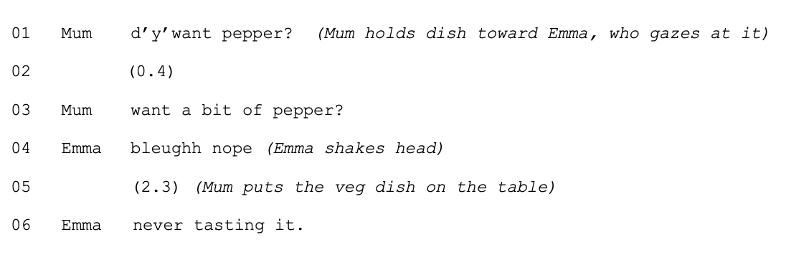
The first thing to note is that the sound has been transcribed as ‘bleughh’ – a more nuanced variation from ‘urgh’, perhaps, though it still doesn’t fully capture the rich texture of the sound6:
That’s the challenge when working with one medium (video and audio) and trying to write about this in another (text): not everything translates across mediums.
If we look at the talk in a bit more detail, we might notice that Mum’s offer of the food is produced twice (on lines 01 and 03). The “(0.4)” on line 02 represents four-tenths of a second of silence in which neither Mum nor Emma say anything. That might seem miniscule, but it is enough to warrant a repetition of the offer with a slight caveat: there’s a tiny downgrade from ‘pepper’ to ‘a bit of pepper’. Perhaps Mum knows that Emma is about to decline the offer and reduces the threshold to make it easier for her to say yes. Emma is, after all, already gazing at the food.
What happens, however, is that Emma produces the disgust sound first and then turns the offer down with a ‘nope’. In this turn initial position (that is, at the start of someone’s turn in the conversation), it appears as if the disgust sound is an involuntary response to the presence of the food and thus provides the perfect account for why Emma doesn’t want it7. But the sound was only produced after the second offer of the food and is therefore in something of a delayed position. Had it been purely a bodily reaction to the sight of the pepper, Emma might have expressed it a lot earlier in the mealtime. Instead, it occurs right at the moment when she is expected to respond to Mum’s food offer.
What is starting to emerge is that sounding disgusted is not only about when the disgust is expressed within the conversation but also the potential trajectory of the food (i.e. the disgust-relevant object) in relation to the person who might be required to consume it.
The second disgust clip follows a similar pattern. This one is taken from a preschool in Sweden in which several children are eating lunch together with their teacher from shared dishes on the table. Johan has a bowl of potatoes in front of him and has noticed a black mark on one of the potatoes. He points this out to his teacher and there is a short discussion about what it might be; Johan suggests that it might be mud or a worm. Surely that would trigger a disgust response? Not at this point, anyway. The teacher concludes that it is just ‘a little spot’. It is only when Peter, who is sitting beside Johan and has been eagerly following the conversation, asks Johan if he will have the potato, that the disgust sound emerges:
Clip 2
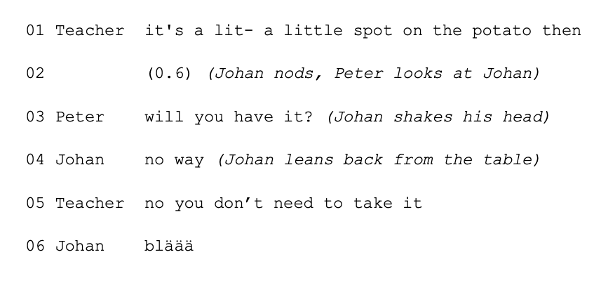
Hear the bläää sound again here:
What happens in this mealtime is a similarly delayed response from the child who has, for at least a minute, been considering what this mark on the potato might be. Had the disgust been purely about an individual visceral response to the object then we might have expected Johan – or Peter – to produce this much earlier on. Instead, it is only when Peter and then the teacher raise the issue of whether or not Johan will have or take the potato, that the disgust sound emerges. In other words, it occurs when there is mention that the potato might end up on his plate rather than when it is being discussed as something he has noticed.
You might have spotted that, in this case, the ‘no way’ (equivalent to Emma’s ‘nope’) is placed before the disgust sound, and that there are also some other things going on: Johan shakes his head and leans back from the table. There are hints of a more performative expression of disgust, and in fact immediately after this clip, Peter repeats the ‘bläää’ sound with a laugh. Sometimes disgust can be amusing, especially with five-year-olds8.
Disgust in time and out of place
The trick to sounding disgusted is therefore not only producing the sound but doing so at the right time. An object might be matter out of place but this ‘place’ might also be the proximity of the object to ourselves. Some objects move, of course, such as broccoli on forks that approach an infant’s mouth (as with Riley in the Inside Out clip), and therefore they become closer to us. Even food that is being offered to children – as with the two examples above – means that they are potentially one step nearer to plates and mouths.
Time and place are thus intimately connected when food is involved, and this is why timing is everything when it comes to sounding disgusted. It is not the object itself that is the issue, but whether that object might be on a trajectory that takes it closer to eating. With their variable format and immunity to conversational norms, disgust sounds enable us to produce this spontaneity while also appearing to be genuinely disgusted.
Broccoli, anyone?
Research references
The following are the research papers, books, or book chapters that are cited in the blog post, in most cases with a hyperlink:
Curtis, V. (2011). Why disgust matters. Philosophical Transactions of the Royal Society B: Biological Sciences, 366(1583), 3478-3490.
Douglas, M. (2003). Purity and danger: An analysis of concepts of pollution and taboo. Routledge.
Goffman, E. (1978). Response Cries. Language, 54(4), 787–815.
Keevallik, L., Hofstetter, E., Löfgren, A., & Wiggins, S. (2025). Response cries and syntax. Journal of Pragmatics, 240, 91-108.
Keevallik, L., & Ogden, R. (2020). Sounds on the margins of language at the heart of interaction. Research on Language and Social Interaction, 53(1), 1-18.
Miller, W.I. (2021). Darwin’s disgust. In D.Howes (Ed.), Empire of the Senses. (pp. 335-354) Routledge. See also Miller, W.I. (1997). The anatomy of disgust.
Oaten, M., Stevenson, R. J., & Case, T. I. (2009). Disgust as a disease-avoidance mechanism. Psychological bulletin, 135(2), 303.
Rozin, P., & Fallon, A. E. (1987). A perspective on disgust. Psychological review, 94(1), 23.
Wiggins, S. (2013). The social life of ‘eugh’: Disgust as assessment in family mealtimes. British Journal of Social Psychology, 52, 489-509.
Wiggins, S., & Humă, B. (2026). Resisting eating during a family mealtime: The moral and identity work of food refusal. British Journal of Social Psychology, 65(1), e70029.
Wiggins, S., & Keevallik, L. (2023). Transformations of disgust in interaction: The intertwinement of face, sound, and the body. Social Interaction. Video-Based Studies of Human Sociality, 6(2).
Wiggins, S. & Keevallik, L. (2026, in press). Disgust at the table: The sequential location and production of young children’s food disgust expressions in the home and preschool. Research on Children and Social Interaction.
- See, doesn’t disgust start to sound a lot more interesting now? Its not all about poo and people coughing in our faces. ↩︎
- There are some caveats, of course. There are some things – like faeces – that might seem disgusting no matter where they are located. That is, until we consider that all the component parts of faeces were once either food or part of our bodies (like bacteria). The important thing is the fact that the poo is now outside of our body rather than part of the alimentary system, which makes it disgusting. Prior to that, it was simply part of our digestive process. If you fancy reading more about poo and the digestive system, Guilia Enders’ Gut is an excellent read. ↩︎
- If you enjoy the prosodic variation in emotion sounds, I highly recommend this emotional sounds map. Just be careful if others might overhear; some of these sounds might suggest you’re not reading a podcast but are watching a very different kind of entertainment. ↩︎
- I promise these are genuine. They really did sound like that. ↩︎
- If you’ve read two previous blog posts, ’Talking with your mouth full’ and ‘Lip-smacking good’, you will of course be very well aware of this. ↩︎
- Researchers who work in phonetics would produce a much more nuanced representation of this sound according to the International Phonetic Alphabet, but instead it has been transcribed here to make it more ’readable’ for a wider audience. And also because I am not a phonetician myself. ↩︎
- If we imagine how it might have sounded if she had said ’nope bleughh’ then we start to see the importance of the order of words and sounds and their timings. ↩︎
- It is not only five-year-olds who might find disgust funny, of course, but perhaps more on that another time. ↩︎
This work is licensed under CC BY-NC 4.0
 Mouth: full