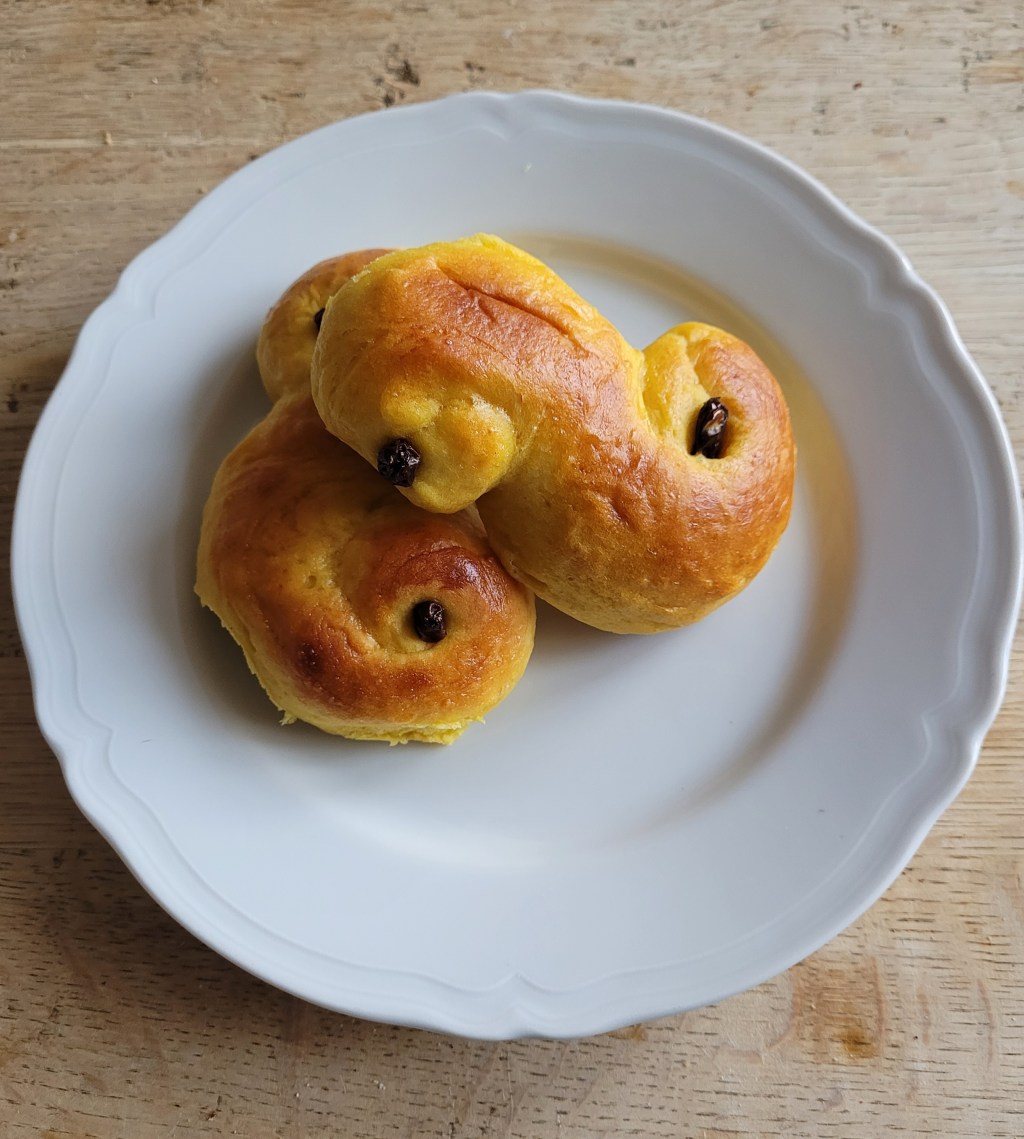
We are approaching the winter solstice in Sweden, and it is cold and dark. We have been eating a lot of lussebullar1 lately (saffron buns: think brioche with a hint of saffron) to celebrate St Lucia day on 13th December. We eat them primarily because they are the perfect comfort food for winter: fluffy but satisfyingly chewy and slightly sweet. More importantly is not just that we eat them, but how, and I don’t mean chewing technique. It’s all about the mood. It has to be cosy: warm, relaxed, with candles or at least low lighting. If it is dark outside, even better. In Danish, this is hygge. In Swedish, we call it mys or mysig (‘moos’/’moos-ig’). But I’m not here to give lifestyle tips; you’ll find those on Instagram. I want to talk instead about how eating gets wrapped up in the stories we tell about our lives.
Lussebullar are just one example of how the ways in which we eat become part of our eating stories. More specifically, it is our tales about how we eat that tell stories about who we are. To explain this, I’m going to need Stanley Tucci’s help.
We are how we eat2
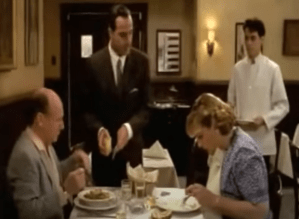
In the film Big Night (co-directed by Stanley Tucci and Campbell Scott, 1996), Stanley Tucci plays Secondo, one of two brothers (yes, the other is called Primo) who try to establish an authentic Italian restaurant in 1950s New Jersey. There is a scene in which a customer asks for a side order of spaghetti to accompany their risotto, and further assumes that the spaghetti will be served with meatballs. Secondo tries to explain that spaghetti is not served alongside risotto nor always with meatballs (in Secondo’s words, “Sometimes spaghetti likes to be alone”), but to no avail. The customers are adamant that their meal is incomplete without the spaghetti. There follows in the kitchen an argument between Primo and Secondo about how the food should be eaten. Primo says that the customer is wrong and doesn’t know how to eat Italian food, Secondo says that they should serve it anyway to keep the customer’s business. It is a powerful scene, and one that highlights the connections between who we are and how we eat.
The scene resonates with academic research around food and identities, that is, how our sense of ‘who we are’ is tied up with the food that we eat. It has long been argued that food is an essential element of our identities, and in particular those identities that are associated with culture, nation, or religion. In a classic study published in the same year as Big Night, for instance, researchers compared Italian family dinner conversations with those in America. The former were characterised with discourses of eating for pleasure and enjoyment, the latter on eating for necessity and morality. What was eaten was somehow less important than how it should be eaten. The same dessert, for instance, might be treated as a reward for eating the main course or enjoyed as a pleasure in itself. The study is an example of how, from an early age, we become socialised into how to eat through the conversations we have around the dinner table.
But it doesn’t stop there. We don’t just learn how to eat and then get on with our everyday lives. We continually re-tell and rehearse our eating stories throughout adulthood. And it is around this time of year that we do it even more.
Re-telling stories
It will soon be Christmas, and like Thanksgiving, Hanukkah, and other celebratory festivals, it involves a substantial amount of food. Not only is quite a lot of our time get spent on planning what to eat, but–for those who celebrate Christmas–we also talk about it with friends and colleagues. We tell each other and rehearse our rituals: cooking the food in just this way, avoiding that food because we don’t like it, eating those foods because they remind us of previous celebrations or loved ones. We might bake Christmas cake but miss out the marzipan, cook ham instead of turkey, avoid the sprouts but prepare cabbage instead. We re-make traditions and establish new ones through the eating stories that get re-told to ourselves and each other. Like the scene in Big Night, it is not just about what we want but how things should be done. It matters how we eat.
Eating stories are around us in the media, too. Celebrity chefs and food writers captivate us not only with recipes but stories about their lives. This is where we need Stanley Tucci again. His recent food memoir, Taste, is an example of how so much food writing is infused with tales of everyday life (see also Nigel Slater’s Toast and any of Nigella Lawson’s recipe books). These kinds of culinary narratives or the telling of food memories are engaging because they blend the mundanity of everyday eating with the unending potential of identities. We learn not only about what to eat but also who the authors are and who we could be. While some cookbooks still perpetuate traditional feminine or masculine roles, and the Instagram posts of chefs might still claim privilege while trying to address sustainable eating, they are public examples of how we define ourselves through the ways in which we eat.
The stories we tell about how we eat are thus scattered through our lives, whether during festivities or at other times of the year. But our lives keep changing, and so our eating stories develop too.
Writing the next chapter
For those who have ever moved to a different country, or who find themselves as a minority culture, the tales of how we eat become more emotionally charged. We need to find ways to negotiate who we are through adapting our eating habits. How do you recreate home when the foods that represent home are not available? When there is no way to access the basic ingredients that you need to make your favourite dishes? Studies on experiences such as those of Syrian refugees in Brazil and Polish migrants in London have shown how not only do people need to adjust their eating habits but also adapt and negotiate their eating stories.
The performance of identity needs to be tweaked, revised, re-established on a continual basis. You have to do this not only for yourself, but for other people. Stanley Tucci’s Big Night is a reminder that our eating stories are always situated in a wider context, always competing with the stories of others.
Despite having lived in Sweden for seven years, I am still asked what we eat for Christmas in the UK. This is where I use that mixed identity to my advantage, and weave together the best of many worlds. Most of us have patchwork histories, connections with different places or people that are meaningful, and more eating stories yet to be written. Alongside the lussebullar, I cook large quantities of Dutch pea soup (erwtensoep) during December to connect with our relatives in the Netherlands. It becomes an exaggerated ritual that rehearses that chapter of our eating story: of the recipe passed down from Oma, of how long it takes to soak and cook the peas, of the importance of finding the right kind of sausages to add. Then we eat a Swedish julbord on the 24th and a Christmas dinner on the 25th because, well, why not? It is cold and dark outside, and it is the season for feasting.
Besides, there is no better way to spend a winter than with good food and plenty of stories.
Research references
Abarca, M. E., & Colby, J. R. (2016). Food memories seasoning the narratives of our lives. Food and Foodways, 24(1-2), 1-8.
Fischler, C. (1988). Food, self and identity. Social science information, 27(2), 275-292.
Hollows, J. (2003). Oliver’s twist: Leisure, labour and domestic masculinity in The Naked Chef. International journal of cultural studies, 6(2), 229-248.
Mapes, G., & Ross, A. S. (2022). Making privilege palatable: Normative sustainability in chefs’ Instagram discourse. Language in Society, 51(2), 259-283.
Matwick, K. (2017). Language and gender in female celebrity chef cookbooks: cooking to show care for the family and for the self. Critical Discourse Studies, 14(5), 532-547.
Ochs, E., Pontecorvo, C., & Fasulo, A. (1996). Socializing taste. Ethnos, 61(1-2), 7-46.
Rabikowska, M. (2010). The ritualisation of food, home and national identity among Polish migrants in London. Social Identities, 16(3), 377-398.
Scagliusi, F. B., Porreca, F. I., Ulian, M. D., de Morais Sato, P., & Unsain, R. F. (2018). Representations of Syrian food by Syrian refugees in the city of São Paulo, Brazil: An ethnographic study. Appetite, 129, 236-244.
Zmora, N., Suez, J., & Elinav, E. (2019). You are what you eat: diet, health and the gut microbiota. Nature reviews Gastroenterology & hepatology, 16(1), 35-56.
- They are often called Lussekatter, particularly if they are in the shape of an S. I’m fairly rubbish at making these look halfway decent, so my 14-year-old son shaped the ones you see in the photo. ↩︎
- The phrase ‘you are what you eat’–typically attributed to Jean Anthelme Brillat-Savarin circa 1825–has become so commonplace that it feels almost meaningless. It is typically used in situations when people are encouraging us to eat more healthily or when they are justifying their own food choices. But there may be more to it than we realised. Recent research on the gut microbiome, those trillions of bacteria and microorganisms that are living in our gut system, is beginning to show how much of an impact our eating habits have on our mental and physical health. ↩︎
This work is licensed under CC BY-NC 4.0
 Mouth: full